The Perfect Sentence
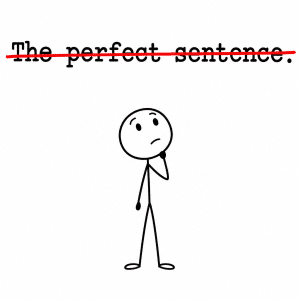 One day, I may write the perfect sentence.
That one isn’t it.
There are sentences I’ve written that I like – and I’ve written a lot of sentences: over thirty books, over fifty short stories, over forty-five feature screenplays, about fifty television screenplays, tons of articles and synopsises and other extraneous material, and about fifteen years’ worth of blogs. None of this includes the obsessive redrafting or word-one rewrites.
It’s a lot of words.
But none of them form a perfect sentence.
I don’t think it’s possible.
There’ll never be a sentence that satisfies everybody. I can accept that. We all have different tastes. There’s not one piece of writing – not one book, one film, one song – that pleases everybody.
You’d go mad trying.
So it’s about redefining where you can draw satisfaction, and that comes from being happy in what you write.
The problem is that the more you write, the more you experienced that you grow, and the better that you get at writing as a craft, the less likely you are to ever be happy with anything you write.
It’s a weird inversion that doesn’t happen in other skillsets. Experience and improvement usually is commensurate with proficiency, and proficiency generates self-confidence. Think about just about any other job, just about any other pursuit. There’s a natural progression.
Not writing.
When you start out as a writer, that’s when you pound out words with such blissful abandon.
You’re sure it’s brilliant.
(I was.)
The truth is you just don’t know any better.
(I didn’t.)
As you learn about prose, characterisation, structure, et al, as you learn about everything that could be wrong with your writing, you start to see everything that could be wrong with your writing, and you develop the humility (or perhaps you simply begin to see through the delusion) to appreciate there could be things you haven’t even considered. The doubt creeps in. Then storms. Then pillages. You start to question if you’re doing it right. That uncertainty attaches to every facet of your writing.
It can be crippling – Franz Kafka (author), Joseph Mitchell (journalist and writer for The New Yorker), and Ralph Ellison (novelist, essayist, and literary critic) are just three writers who struggled with crippling insecurity about their talent, despite (or perhaps as a result of) the success they’d experienced previously.
I use to think if I could get something right, it would enjoy success, but that’s another fallacy because we have no control over whether something’s read. Plenty of good books have disappeared into obscurity and shit books have become bestsellers. That’s art. And consumerism.
All we can do is our best.
That’s what time, practice, and experience have taught me. Now it’s not about material reward, but about finding satisfaction in the writing – enjoying the journey and appreciating those times I can like (however briefly) something I’ve written.
I don’t think I’ll ever write the perfect sentence, and if I did, I don’t think I’d ever write again.
So maybe there’s a greater pursuit and more worthwhile beauty in imperfection.