Panic City
1989
That Other Me is a series that explores the immediacy and intimacy of various mental health episodes I’ve experienced throughout my life.
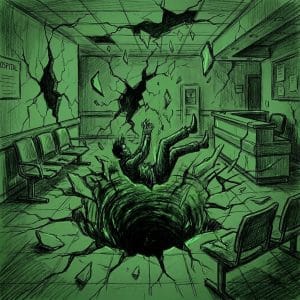 I sit in the lobby, waiting to see my psychiatrist. Since that initial panic episode that introduced me to the public health system, these appointments have been little more than check-ins to say, the occasional anxiety aside, I’m doing okay. That’s what I expect this afternoon. I felt good in the morning.
And then, it’s nothing but the fear, terror, and panic that instantaneously immerses me until that’s all I am, and my conscious self is sinking right out of it, squeezed out to a place where I’m disembodied, with no control or hope. This morning’s composure, the control I’ve wrestled back over the previous few months, evaporates, like it’s never been there – not just in the last few months, but ever.
I would call out for help if anybody was available. Usually, there’s a nurse sitting at the head of the lobby, or there’re other patients. But today the lobby is empty. It’s just me and rows of chairs. I could charge out of here, and find somebody else. This is a public hospital, after all. But it’s impossible to move.
My psychiatrist is late. I don’t know who he’s seeing, but their appointment is running over time. That’s some small comfort that peaks through. The psychiatrist must be close to finished. Then I can rely on him. He deals with this all the time. He deals with this. He’ll know what to do.
It’s the briefest assurance that steadies me.
I’m okay.
Then it comes again: the anxiety obliterates everything I am, until I’m nothing more than a plummeting, diminishing consciousness, funnelling out of this world and leaving just the overwhelming panic behind.
I want to scream out to my psychiatrist – want to charge over to his door and thump on it and demand I need immediate help. It’ll be a terribly rude imposition on his current patient, but surely his current patient would understand. This is not manageable. That patient must know that. That’s why they’re here, too. And, selfishly, the very act of intrusion will show my psych just how horrible this is.
It keeps striking – faster and harder, until it’s one sustained assault. There’s no fixing this. There’s no escaping this. And there’s no surrender. Only resignation. That’s what remains when hope disappears. I can just leave this to whatever comes next. It might be awful, might be ungodly, but it’s a better option than holding onto something that’s not only slipping away, but exacerbating everything I’m feeling just by trying.
The months of simmering anxiety, depersonalisation, and weird thoughts mean nothing. They’re the static between radio stations. I’ve tuned into something else now, some station I always feared I’d find. Panic City. It’s blaring now. Blaring louder. Blaring deafeningly.
The door opens.
My psych walks out a patient – some twenty-something man. They chat amiably, engaged in some meaningless farewell. I rise. What’s with this nothing chatter? They had time enough to do that during their session. I silently curse them and urge them to be done. The psych finally sends the patient on his way.
I thread my way through them and make my way into my psych’s office.