That Maddening Imperfection
1993
That Other Me is a series that explores the immediacy and intimacy of various mental health episodes I’ve experienced throughout my life.
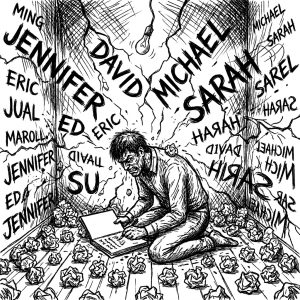 The tail on that letter “y” isn’t right.
I’m scribbling down my characters’ names for a story I’m writing. This is part of my standard practice. I always write down the names of every character I think I might possibly use, often overcompensating and ending up with lots who are never called upon. But that’s okay. I need to intimately know the world where my story takes place, so I populate it as densely as possible. You rarely get lost because wherever you go, there’s always somebody to turn to.
But the tail on that “y” isn’t right.
I tear the A4 sheet out of my folder, scrunch it up, and flick it casually over my shoulder.
Let’s go again.
The title of the story at the top of the page.
Underline.
The name of the main character. The supporting character. This is looking good so far. Whenever I begin to write, it’s neat. The problem is the more I write, the more the legibility progressively deteriorates.
Shit. The curl on a lowercase “t” goes under the line on the page. That won’t do.
I tear out the A4 sheet. Crumple it up. Throw it.
Start again.
There are no fixed rules to this, no exact lettering I must produce. It’s not like there’s some aesthetic standard I must hit with every attempt, which is something they drilled into me at grade school. The problem is my thinking outpaces the steadiness required for such handwriting. So there’s a compromise between speed and presentation – at least initially. Then there’s a capitulation. Speed always wins.
But I do know that when it’s not quite right early, a feeling informs me that I can’t keep going on. If I don’t get this right, then I won’t be able to get anything right from this point. It’ll nag me. Unsettle me. Make me anxious. These aren’t states conducive to being creative.
I could type the names out. A psychologist suggested that to me once. But I need these names to go from my brain to my hand to my fountain pen to ink on the page. There’s nothing more intimate than how the nib of my fountain pen scratches across the page as an extension of my thinking. A computer is so impersonal.
White-out has also been proposed, but that only covers an error – it doesn’t undo it. I know it’s still under there, a malignancy that threatens everything else written around it. The white-out also creates its own blotch. These aren’t solutions. They’re just different problems.
So the room fills with scrunched-up balls of paper. You can’t see the floor anymore. And I know it’s a terrible waste – all these destroyed A4 sheets, often with only one or two names committed to them. I feel guilty some tree died to produce this paper, that each sheet had a single purpose in existence – to be used – and they’ve been desecrated like this.
There is no fear I will never get it right.
I will, sometime.
Time has taught me that much.
And, peculiarly, I also know that if I can get enough text on the page, the weight of it outweighs the compulsion to start over, and from there my writing can degenerate – well, at least in reason – and I’ll be okay with it.
So I keep trying, keep writing, keep scrunching-up, knowing this might take anywhere from a single minute to a single hour to a single night.
But I will get it.
I know I will.