Selling Your Book
THE BIG IDEA
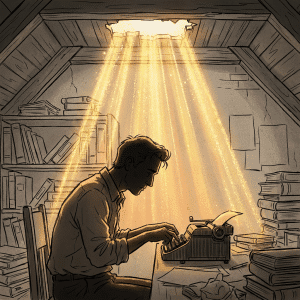 You’ve got it, have you?
You’ve got that story idea that you’re sure WILL SELL.
The story you want to tell trumps everything else that’s out there.
You have a divine certainty that it’ll be a BESTSELLER.
You’re so sure, you just wish people could experience the certainty you do.
You’ll show them.
You’ll show them all.
Your book is going to be THE BIGGEST HIT EVER.
Right?
Well, as somebody who’s written for over forty years, and worked in publishing for nearly twenty years, I have one question I need you to answer:
WHY?
Because the story rocks, you’ll tell me.
And?
IT IS JUST THAT GOOD.
Okay. For the sake of this argument, for the sake of this exercise, let me concede that you have a story that is THE GREATEST STORY IN THE WORLD.
Let me ask you this: Why will it sell?
And, no doubt, you’ll tell me again, because it’s THE GREATEST STORY IN THE WORLD.
Here’s a follow-up question then: How are people going to know your story exists?
BECAUSE, you’ll tell me again, IT’S THE GREATEST STORY IN THE WORLD.
Okay, great. You’re not getting this, though. You write it, get it published, but how do people know that the story now exists in book form?
BECAUSE, you repeat, IT’S THE GREAT—
Sigh.
How are you going to make people aware your book exists so they will go out and buy it?
BECAUSE—
No, this doesn’t work. Writing the story doesn’t sell the story.
Those are not only two different things but they’re almost exclusively two different things.
There are tons of great stories out there, too. You’re not special, even if you want to think you are. I know lots of great writers who just haven’t sold many books, and it’s through no fault of their own, their writing, or the quality of their story.
This is where so many authors – particularly inexperienced authors – struggle.
There’s a chasm here.
On one side is the book.
On the other is the sale.
And between them is an indefinable distance, and bottomless abyss, that swallow the best of intentions and welcomes the biggest of delusions.
Something we often tell authors is, Writing the book is the easy bit compared to selling it.
So here’s the biggest reality you need to embrace, as prickly and unembraceable as it is: you might’ve written the most beautiful story of all time, and your writing might be mesmerizing, but nobody’s going to buy your story – your book – if they don’t know it exists.
And the book’s not going to spruik and sell itself.
This is something that a lot of writers with THE BIG IDEA overlook – they expect all they have to do is write the thing, and suddenly it’ll sell itself, as if it’ll stand on street corners like some garish prostitute and hustle passersby while the author lounges at home, feet up, just waiting for the money to roll in.
The book is a product.
That’s all.
And it’s a product that drowns in a saturated market.
Here’s a scenario to imagine: go into a bookstore. Look around you. How many books are there?
Hundreds?
Thousands?
The bookstore’s not going to give you prime real estate in terms of shelving over established authors like Stephen King, Jodi Picault, Liane Moriarty, etc. Those authors are going to sell without trying. That’s why they have the prime real estate – so browsers can see they have a book out and buy it.
The casual browser is most likely not even looking for a new author to enter their lives. They’ve probably gone in either with an agenda (e.g. they know what they want to buy, or at least have an idea what they’re looking for), or to see what their favourite authors might have out. And then, behind that, they’re looking for some cheapies on those discount tables (which isn’t the best model to build success upon), or they’re just there to kill some time.
Go search an online retailer like Amazon. How many hits do you get? Thousands? Hundreds of pages? Tens of thousands of titles? Multiple your physical bookstore experience a hundredfold, and then filter that through the mechanism of perusing books in a two-dimensional space – and sometimes perusing those books on a small device (like a smartphone), which diminishes their appeal.
Now, I’m sure somewhere in the world some book has randomly gone viral, e.g. Fifty Shades of Gray. But that’s not the rule. That’s the exception.
If you think about how you buy books, most times it’ll come through some sort of recommendation – you’ll see a review, or a friend will tell you that you just have to read a certain book, or there’ll be some hot murmuring about a title, so you buy it (or borrow it) to see what the fuss is.
This is important to understand, because it’s a big part of the book discovery and buying process.
Creating awareness.
And it’s always better if you start doing it in advance – before the book’s published. You can still market an existing book, but the beauty of new books is they have the new book smell – and all the buzz and hope that permeates that.
Pantera Press published my novel Just Another Week in Suburbia in September 2017, but their publicist came out in January to talk to me about the marketing, and the strategy she was employing to build interest in the book so that there would be hype and desire around its release eight months later.
Here’s an easier way to think about it: I often compare selling a book to the way studios sell movies.
Think about James Gunn’s Superman. That didn’t just premiere and we’re all walking around, astounded, that a new Superman movie we knew nothing about beforehand is now out at cinemas.
Besides the hubbub the Warner Bros’ publicity machine created around James Gunn taking on the project, the excitement around casting, and the conversation around tactically released pics (e.g. What’s the new suit look like? What’s David Corenswet look like in it?) they started advertising the movie’s July 2025 release back in about November 2024.
They released a teaser. Then there was another teaser.
(In one teaser, Superman flinches, his eyes blinking closed, when somebody throws rubbish into the back of his head. Fandom was outraged that Superman would respond like that to rubbish given he can withstand bullets. The flinch was edited out of the release. I think it was purposely left in there to generate discussion, because discussion maintains awareness, and the correction cost them nothing.)
Then there was a trailer. And another trailer.
The actors started doing press.
And so on.
There was a whole marketing plan built around creating as much sustainable awareness for the movie as possible so that people kept talking about it, and thus when it did come out, audiences were eager to see it.
(I’m sure there were even audiences who loathed it out of allegiance to Zack Snyder’s incarnation, Man of Steel, and went to see it just to hate on it.)
Now not one of us have the resources of Warner Bros or the exposure of James Gunn. But still, we do whatever we can to create that awareness around us (as the author), and our book.
Think about how you can get yourself out there.
Years ago, I saw Matthew Reilly talk about sitting on buses, holding his first (self-published) book up as if he was reading it (but ensuring everybody could see the cover), and making appreciative noises, as if he was really enjoying it.
Effective? I don’t know. But it does showcase a lateral approach, so kudos to him for trying any means possible to get his work out there.
A lot of people will immediately think of what they consider BIG ADVERTISING, e.g. imagine getting an interview on a morning breakfast show, or buying advertising on a big billboard on a busy freeway.
These sound great in theory, and if you can finagle (and afford to splurge the money without impacting your life), sure, go for it. But I always consider these sorts of ploys as impermanent and limited.
For example, you get an interview on a morning breakfast show, and between 8.30 – 8.40, you regale the hosts with your wit and charm. You dazzle them. They’re entranced. You walk away happy and satisfied.
Great, huh?
But if I wasn’t watching that morning breakfast show, then I haven’t seen your interview. Nor is it replayed somewhere where I might catch it. It’s gone. If I lived in another state, or in another country, there’s no chance I’ve seen it because those places would have their own morning television.
Same with the billboard. Unless I’m driving down that freeway, I’m not going to see it. That billboard in Greensborough, Victoria, means nothing to me in Manly, New South Wales, or New York, USA. It probably won’t even mean much to me if I live in the next suburb and never drive down that way.
Then let’s throw in that you’re pitching to random markets. One-hundred thousand people might drive down that Ring Road every day. How many of them are readers? Even if they are readers, how many of them are cognizant of billboards? Right then and there, how many of them are in buy-a-book mode as opposed to simply being preoccupied with getting to where they want to go?
These tactics have a limited reach geographically, in the time they’re available, and just how much they’re engaging the audience (or whether they’re engaging the correct audience at all).
The word I implore authors to remember is permanence.
Do things that last.
Social media’s the easiest recourse nowadays because we all have access to it. Instagram and TikTok have huge book subcommunities: #bookstagram and #booktok. Those are audiences dedicated to books and reading you can try appealing to, rather than taking your chances on randoms.
Think about reviews – there are review platforms who offer these services professionally. Most of them charge quite a bit and while they promise reviews here, there, and everywhere, I’m unsure it’s worth the cost.
Also, while some might promise big audiences on their platforms, in many cases they’ve probably bought followers to create the illusion they’re heavily populated and frequently visited.
You have to make your own judgement on whether you’ll use these types of services (although I will offer the caveat that legit platforms don’t solicit you, offering to review your book, and then hit you with an invoice).
Most review bloggers will have websites with contact details you can hit up. Some will charge. Many won’t.
There are podcasts, too, who talk about books and/or your genre or subject matter. Think about how you can cross-platform. For example, if your book’s about World War II, you might be able to approach podcasts about authors, about books, about historical books, about history, and about the war – that’s five different possibilities.
The internet’s forever. I can still find reviews to my own books that came out back in 2017. I listen to podcasts that were recorded ten years ago. These are things that – short of a nuclear war – will be around forever and are always a chance of being discovered.
So while your book should enjoy all the excitement commensurate with a new release, it’ll also have a chance of connecting to potential readers forever.
But just remember the most important lesson here: just writing the book doesn’t sell it.
That, ultimately, relies on you.