Star Trek V: (Beyond) The Final Frontier?
If you ask any Trekker which is the worst of the original series movies, they’ll tell you Star Trek V: The Final Frontier.
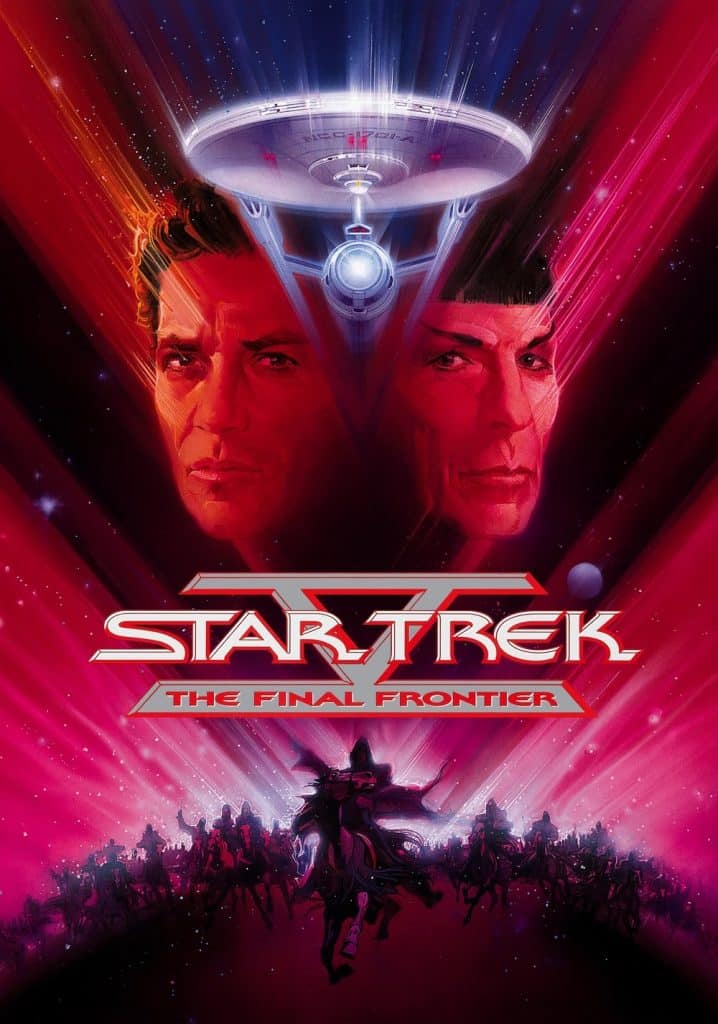 In it, Kirk and company’s shore leave (on Earth) is cut short because they’re required to take a very new but underprepared Enterprise 1701- A to Nimbus III, where Federation, Klingon, and Romulan ambassadors have been taken hostage. When they get there, the Enterprise’s crew find the mastermind is Sybok, Spock’s half-brother – a man we never knew existed – and that this has all been a ploy.
Sybok has an ability to free people from their psychological and emotional pain, after which they become unquestioningly devoted to him. He’s raised a whole army of followers to help him with a quest that came to him in a vision: to find God, who lies beyond the Great Barrier at the center of the galaxy.
The story’s a mess.
Lucasfilm were committed at the time and unable to do the special effects, so they’re also a mess.
And the film as a production is … good.
Leonard Nimoy directed Star Trek III: The Search for Spock and Star Trek IV: The Voyage Home, so William Shatner thought it was time he took on the responsibility. His direction’s good, and overall he does a fine job, with a couple of scenes standing out – one that’s among the best scenes in Star Trek canon.
But the biggest marvel to emerge from Star Trek V is that it’s the one Original Series movie that genuinely feels like the Original Series. That’s not to say the others don’t belong. They’re still Trek. It’s not like they ditched everything that made the series such an enduring success. But narratively?
Star Trek: The Motion Picture is Gene Roddenberry’s representation of what he wanted for Trek. If you look at the original pilot, “The Cage”, starring Jeffrey Hunter as Captain Pike, it’s a much more cerebral adventure. Roddenberry was charged with shooting a new pilot. Enter William Shatner’s Captain Kirk. And a fist fight. While the series is (usually) replete with smart sci-fi, it’s action-based.
The Motion Picture feels like what Rodenberry would reinvent with Star Trek: The Next Generation – a staid captain, a hot shot first officer (in love with another crewmember, whom he’d abandoned), and this intellectual exploration of what it means to be human. If you substituted Jean-Luc Picard for Kirk, Commander William Riker for Will Decker, and Data for Spock, you’d have something that’d comfortably fit in The Next Generation.
Nicholas Meyer helmed Star Trek II: The Wrath of Khan and Star Trek VI: The Undiscovered Country. You can credit Meyer for not only revitalising the franchise, but restructuring how it would function, building the foundation that is the base of The Next Generation, Deep Space Nine, Voyager, and Enterprise – well, all Trek that’s followed.
Rodenberry complained Meyer’s vision was too militaristic, although I think if you look at The Wrath of Khan and The Undiscovered Country, Meyer helped the series transition into something that could work cinematically. They feel like BIG STORIES. When you get television properties becoming movies, that doesn’t always work. When Hollywood was adapting all those TV shows into movies back in the 1990s, a lot of them felt like glorified television episodes too small for the big screen.
The very underrated Star Trek III: The Search for Spock is an intensely small and personal story – one that’s only getting the plaudits it deserves now, while Star Trek IV: The Voyage Home is this quirky comedy that isn’t afraid to make fun of the characters. They’re both great movies, but neither feel quite like the series.
Star Trek V: The Final Frontier is exactly what the series promised: to seek out new life forms, and new civilisations, and to boldly go where no man has gone before. While The Motion Picture explores a new life form, the characters are reined in and intellectualised until they’re playing stoic versions of their television incarnations – even Spock, who feels almost cardboard compared to his previous portrayals. The Final Frontier – a few misplaced stabs at humor aside – feels like it’s representing the characters as we knew them in the series.
It’s a shame more wasn’t done with Frontier’s script. Who – or what – is the entity the Great Barrier imprisons? Is it just an alien entity (I wrote fan fiction decades ago that made it an imprisoned Q)? Or is it the manifestation of why Vulcans do deny their emotions and embrace cold logic? Or is it something else entirely?
Instead, we’re bogged down with the ridiculous premise that Starfleet would send an ill-equipped ship to Nimbus III. Whereas a fully functioning ship could’ve just beamed the hostages off the planet, the Enterprise’s transporters aren’t working. So Kirk goes down, and Uhura lures Sybok’s forces with the equivalent of a siren’s dance atop a sand dune – I don’t know why the communications officer was sent on a raid, or why she brought the get-up she uses in her dance.
(As an aside, I would’ve rather left Uhura onboard to command the Enterprise in Kirk’s absence, and sense Chekov on the raid – that feels like a missed opportunity.)
I cannot praise Laurence Luckinbill enough in his portrayal as Sybok. He’s charismatic, enigmatic yet sympathetic, and engaging. But how does his capacity to free people of their emotional trauma enslave them to his cause? I also think it’s unfair on Trek’s supporting cast (Uhura, Sulu, Chekov) that they unquestioningly embrace Sybok, which means they’re betraying Kirk, Spock, and Bones. It’s that easy to flip them? That in itself feels like a betrayal.
The “center of the galaxy” premise is stupid. Where is the center of the galaxy from Federation space? According to Grok, it would take 17 – 18 years to get there using TNG’s Warp 9 as a standard, and in TOS they rarely travelled at those speeds. And if it is reachable and there’s a Great Barrier there, surely Starfleet and/or one of the other alien governments would’ve already investigated it further.
It’s just convenient contrivance to try make the story work. The scene that sums the plotting up is when Kirk and McCoy are scaling the turbolift while trying to escape Sybok’s forces, and Spock appears in his rocket boots. So while Kirk, Spock, and Bones were being pursued, Spock had time to duck out, get his rocket boots from wherever they were (presumably his quarters), and come back to find Kirk and McCoy? There’s no sense to this. It exists because it needed to.
Shatner has openly talked about the problems he had in trying to realize his story – originally, he wanted the Enterprise to go in search of God, take a trip to hell, meet the devil, and all this other crazy stuff. Both Gene Roddenberry and Paramount objected to the strong religious overtones, so the quest was changed to an alien who thought he was God. According to Shatner, that’s where his vision started coming apart.
In Shatner’s memoir, Star Trek Movie Memories, he talks about all the technical issues they experienced, and how much that compromised his vision. Well, those things might’ve improved the movie aesthetically, and might’ve added bits of tension here and there, but they wouldn’t have done much for the story.
The scene that stands out as one of the best in Trek is when Sybok tries to convert McCoy, Spock, and Kirk to his cause. McCoy faces the pain of euthanising his terminally ill dad, only for a cure to his dad’s malaise to be found later. Spock sees a memory that when he was born, his father immediately rebuked him for being so “human”. The McCoy thing is a bit cliché, but I love the Spock thing – all the time we’ve known him, he has tried to be the perfect Vulcan; now we see a big driver behind that. If his father was this disapproving at birth, what sort of parental figure was he through Spock’s life? (Although you do have to question why Sarek would be so disapproving of a human son given he’s the one with a human partner – what did Sarek expect? A pureblood Vulcan child? That’s illogical.)
I especially love the way Kirk refuses to face his pain – Shatner’s awesome in selling that our pain makes us who we are and drives us, and if we take it away we lose something of ourselves. Shatner’s acting is often lampooned, but in scenes like this – just like when he deals with his son David’s death in Star Trek III, and during his “buried alive” interplay with Khan in Star Trek II – he shows he has range, depth, and verisimilitude.
I wish this story had focused more on the character interplay, as well as on the villain – this new life, and what it meant, rather than just making it a one-dimensional villain they find, then have to escape.
The adventure could’ve been the best of the lot.
I’d love to know if a director’s cut would reimagine a fuller story. And I’d love if they filmed my fanfiction.
Come the end of the movie when Kirk’s alone and facing the entity, he’s beamed off the planet. In the movie, he appears on the Klingon Bird of Prey. In my fanfiction, he first reappears in this featureless black landscape and is greeted by TNG’s Q (John de Lancie).
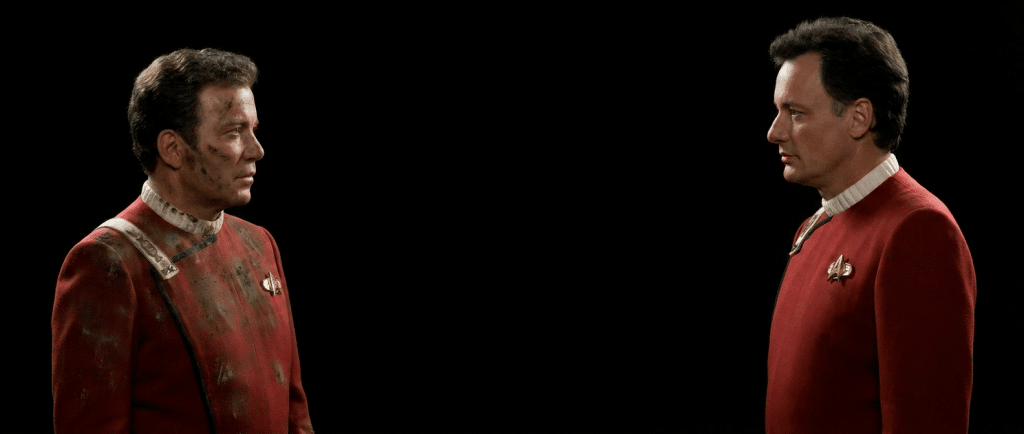 Q tells Kirk that mortals are going where they don’t belong, and risked freeing an imprisoned member of the Continuum who would’ve reined hell on this universe and beyond, and when Kirk protests that exploration is a human need, Q warns him if they continue adventuring recklessly, they risk their own well-being. Q finishes by says he’ll check in again to see if the humans have heeded his warning, then sends Kirk on his way to the Bird of Prey.
Which, of course, they haven’t come the time of TNG.
It’s a little contrived (and obviously I have to work within the confines of what’s on screen), but I thought it would’ve given some context to the entity, and been a nice linkage between the two Treks.