The Not-so-Superman
Superman isn’t that hard to write.
But lots of people will tell you he is. After all, how do you write a story that’ll challenge a superhero who’s essentially a god? Who’s overpowered? Who has no match physically? Who, kryptonite aside, is invulnerable?
Years ago, DC Comics created the monstrously monstrous Doomsday to answer that call. He and Superman punched it out, Superman died, rejuvenated, and came back – a narrative choice that makes him even stronger. Now you’re saying he can’t die.
But Superman’s strength and powers aren’t the problem. People think they are because they’re asking the wrong question. That much is evident in the recent cinematic stabs at Superman, which is probably why I remain biased toward Richard Donner’s versions – well, for that reason, and because they’re good movies.
 For those who don’t know, Donner (who later helm the Lethal Weapon franchise, among other hits) was filming Superman and Superman II back-to-back. He’d just about finished Superman when he had creative differences with the producers, Alexander and Ilya Salkind. Donner was fired and a new director, Richard Lester, was hired to direct and finish Superman II. To warrant the director’s credit, Lester had to film at least 51% of the movie, which also meant he had to refilm large portions of it.
In 2006, Margot Kidder (Lois Lane) said Donner had filmed enough to turn in his own cut. A petition arose – the first fan petition to demand a director revisit a property and give us their version – and that’s what we got. Donner cobbled together his cut from what he’d filmed, screen tests, and (begrudgingly) used Lester footage to fill in gaps.
It’s only a façade of what might’ve been, though – obviously, we didn’t get what we would’ve had Donner originally been able to finish the movie. He had to compromise, and you get the feeling (watching it) that, sometimes, Donner’s made creative choices simply to differentiate his version from Lester’s, rather than because it was the best scene for the movie.
A great example is when the Kryptonians are at the Daily Planet looking for Superman. Superman lands on the flagpole outside Perry White’s window. In the Lester version, Superman says, “Would you care to step outside, General Zod?” It’s so wonderfully juvenile and yet fitting given the destruction the Kryptonians have wreaked. In Donner’s version, Superman says, “General, haven’t you ever heard of freedom of the press?” That feels like some clever line somebody came up with, but didn’t play as well as they imagined.
Still, Donner’s version is better than the theatrical release – it respects the canon, restores Marlon Brando’s Jor-El, and removes all the goofy comedy Lester insisted on inserting (and that litters Superman III, which is exclusively Lester’s vision).
Bryan Singer directed Superman Returns in 2006, which continues from Superman II (thus ignoring Superman III and Superman IV), and plays like a homage to Donner and Christopher Reeve’s Clark Kent/Superman. It would’ve been nice to see what Singer and Brandon Routh (Clark Kent/Superman) might’ve done in a sequel once they were freed from those constraints.
It’s not a bad movie, but answers the question that nobody asks – what would Superman be like as a father? There are some gorgeous set pieces in it: Superman rescuing the plane, hovering above the Earth and listening to cries for help, and flying up above the clouds to regenerate, among the best Superman scenes ever filmed.
Zack Snyder took up the mantle with Man of Steel and gave us a visually gorgeous film that’s not so much Superman, but what Snyder imagines Superman should be if we were to drag him into today, with today’s attitudes, and Superman became a polarizing figure who inspired worship, paranoia, and distrust in equal measures.
I’ve always found it funny that Snyder’s Superman doesn’t have the red trunks in his costume; Snyder’s said he just couldn’t find a way to justify them. Snyder has no problem justifying giant dragonflies as a mode of transport on Krypton, a Kryptonian Codex that determines caste births, and an alien landing on Earth and dressing up in tights to become a superhero, but has a problem with the trunks. We certainly don’t want to puncture that suspension of disbelief, do we?
Snyder applies the same methodology to Batman vs Superman and The Justice League. They’re a hodgepodge of stunning visuals, dumb plotting, and characteristic inconsistencies. Not one of the superheroes is what they need to be. The movies are gorgeous, though – visually epic. And Henry Cavill is magnificent. Imagine if he got to play Superman (which, I’ll argue, he only really got to do in the Joss Whedon scenes in Justice League).
I wanted to love James Gunn’s Superman but I just can’t. Gunn’s quip-heavy style and constant narrative subversion to facilitate dry (and often dumb) humour robs Superman of the one thing that should be the core of his being: his nobility. Even Snyder got that part right. Gunn’s Superman feels pedestrian at times – more like Superboy than Superman with a story geared toward a five o’clock audience.
It also feels as if Gunn tries to answer criticism levelled at Snyder’s Superman – whereas Snyder gives us a Superman questioning his role among humans, whether he can be a saviour, and seems oblivious to the death and destruction occurring around him, Gunn gives us a Superman who overservices humanity and rescues dogs and squirrels.
Now here’s a big part of the problem with today’s incarnations of Superman – and a problem that’s bugged so many Superman creators: both Snyder and Gunn revert to punchfests to end their movies; in Man of Steel, Superman punches the world-building terraforming machine in the nose (even though as it terraforms Earth into Krypton, it should be disempowering Superman), then beats Zod in a battle of strength; Gunn’s Superman fights Ultraman.
Here, you have both directors thinking Superman’s only match can be somebody equally as strong. Gunn also give us the farce that Lex Luthor can dictate what moves Ultraman should use in a super-powered fight, and it all really just amounts to more punching.
This is what I love about Donner’s punchfest in Superman II: Superman realizes he can’t win purely through strength, and trying to do so will result in countless innocent people being killed, so he moves the battle away from Metropolis to the Fortress of Solitude and outsmarts Zod, Ursa, and Non. That’s right: he doesn’t just keep punching them, but outwits them.
In fact, Superman III, which isn’t a good film, continues the theme of Superman outsmarting the villain. This is an important factor that these other properties miss: Superman isn’t just superpowered and honourable, he’s also extremely intelligent.
In Superman III, Superman outwits a supercomputer that doesn’t realize the cannister of Beltric acid he’s holding becomes extremely corrosive at a certain temperature. It’s not the most genius of twists, but at least it shows Superman thinking up an intellectual solution, rather than a physical one.
So let’s go back to my assertion that Superman isn’t that hard to write: Snyder uses Zod, the Kryptonians, then Doomsday, then Steppenwolf as antagonists who are just as capable as Superman physically. Every movie is about Superman punching his way to victory. The whole plot of the Justice League is to resurrect Superman because he can punch harder than the rest of them.
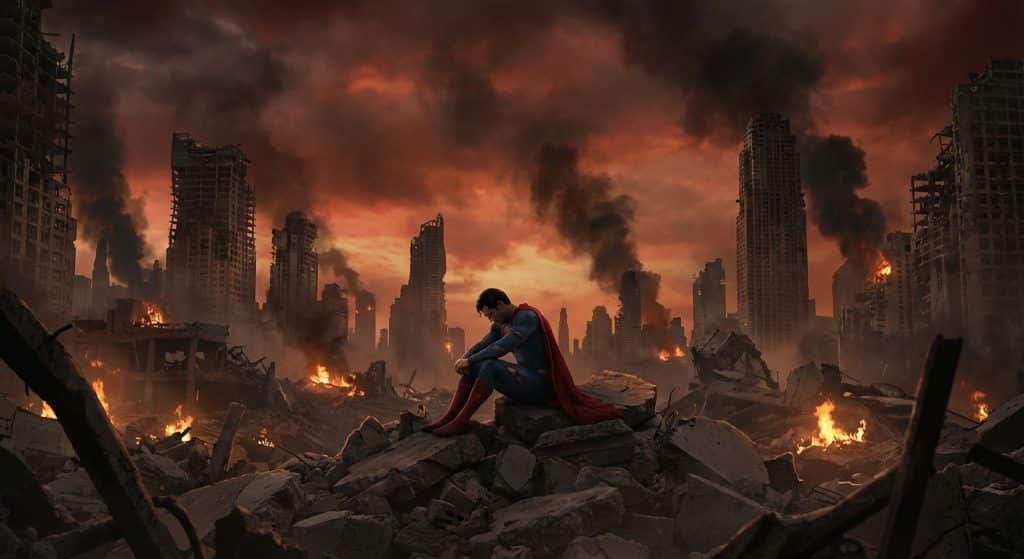
But while that’ll make for some sweet visuals – and there are beautiful apocalyptic levels of destruction happening – that’s not how you beat Superman, nor create a problem that’s going to be a credible match for him narratively.
Here’s a quick but important aside: in Christopher Nolan’s The Dark Knight, the Joker captures Harvey Dent and Rachel Dawes, and plants them in separate locations with bombs ticking down to explode. The Joker gives Batman both locations. Batman is tricked into going to rescue Dent instead of his love, Rachel; Rachel dies, while Dent is horribly injured.
When we next see Batman, he’s still in his batsuit, but is unmasked as Bruce Wayne – this is an important distinction: he’s allowing himself to be human now, rather than the icon in Batman. Bruce is struggling to process the loss of Rachel. But he will. It’ll haunt him and hurt him the rest of his life, but he’s human – he knows he couldn’t be in two places at the same time to rescue both.
Superman possibly could’ve been.
What if we double the quandary? How about we have Lois Lane, Jimmy Olsen, Perry White, and some other character hidden in different locations with bombs ticking down? How does Superman handle this? Can he rescue them at super speed? What if he’s forced to make a choice that would result in a death? What if he was forced to sacrifice one?
One thing I like about the awful Andrew Garfield Spider-Man movies (and I should make clear they’re not awful because of Andrew Garfield, but just because they’re wonderfully awful) is how the death of Gwen Stacy occurs (although I appreciate this is taken directly from the comic books). She falls from a great height. Spider-Man shoots a web to catch her. He does catch her. But the abrupt halt results in a whiplash that breaks her neck.
Is that something that would happen with Superman rescues at super speed?
In the underrated John Wesley Shipp Flash TV series from the 1990s, The Flash’s suit had to be made from a special material, because running at that superspeed shreds ordinary clothes. He also constantly eats to replenish because, as the Flash, he’s burning so much energy.
I bring up these scenes just to highlight there are consequences to being super that the Superman cinematic properties rarely explore.
One thing that annoys me in so many superhero properties (but it’s usually more the demesne of TV series, and it did occur both in Smallville and in Lois & Clark: The New Adventures of Superman) is the inevitable power-swap story line: the protagonist gets struck by lightning or whatever, and their powers are swapped into somebody else. This assumes just anybody can wield these powers. Surely there’s training to it.
Even Superman had to learn to master his powers as he grew up. You can’t just inherit them and be awesome at them immediately. You should be more like the Greatest American Hero – you might have the extraordinary abilities, but don’t have the skill or mental acumen to wield them.
This is an important thing to keep in mind. Too many of the Superman properties deal with Superman as an absolute. He just is. Richard Donner’s Superman deals with young Clark learning that for all his powers, he cannot save his father from a heart attack. Even Zack Snyder deals with a juvenile Clark unsure how to cope with x-ray vision.
This is great stuff, and while some of these questions would be resolved through age and experience, other things would continue to trouble Superman in adulthood.
In Donner’s Superman, Superman again has to deal with loss – with Lois’s death. When his foster father, Jonathen Kent, dies from a heart attack, Clark’s forced to confront that his powers were useless. He’s again faced with that conundrum when Lois dies. This could’ve been an important philosophical beat in the life of Superman, but his solution (of spinning the world back in time, or going back in time – it varies, depending on whose interpretation you trust) undoes the cost.
Superman Returns has that one scene of Superman hovering above the Earth, listening to people cry for help. Later, he tells Lois that she wrote an article saying the world doesn’t need a saviour, but every day he hears people crying out for one.
How does Superman cope with this? We continue the façade of Superman working a 9-to-5 job as a reporter, or having casual interactions with Lois Lane over the water cooler, but while he’s doing these things, somebody’s being robbed, somebody’s being assaulted, somebody’s being murdered – does he just ignore the pleas for help during these hours? What about accidents? Is he just sitting there in some staff meeting, talking about covering the local dog show, while he listens to somebody being murdered? Or somebody dying in a car accident?
When does he decide to help? When doesn’t he? Does he shut out these calls to preserve his sanity? How does he go on knowing people are dying while he’s catching up with Lois for coffee? Can he have a life outside of being Superman? Could Clark Kent even exist in the Superman universe?
During the latter part of Smallville, Clark would rescue people as his precursor to Superman, The Blur – that’s all people saw: a blur as he moved at super speed to effect a rescue. In one episode, one woman laments he wasn’t there to rescue her husband. How does Clark deal with that responsibility? With that guilt trip?
Smallville explored the loss of just that one life. According to Google, approximately 150,000 – 175,000 people die every day (although I imagine it’d have to be much more currently). In New York (which I’ll use as a parallel to Metropolis), 150 – 160 people die every day. About twelve of those are a result of crime or accident.
Here’s a seemingly complete aside: in Star Trek: Voyager, the ship’s doctor is killed in the pilot, so they activate an medical hologram that’s meant to operate as a stopgap doctor in an emergency. But now the hologram, who comes to be known simply as the Doctor, has to operate full time, so as the series goes on, he develops relationships and had experiences that he was never programmed to deal with.
In one episode, they bring in two gravely injured crew – one, Harry Kim, is the Doctor’s friend; the other is some nameless crewmember.
The Doctor can only save one and makes the decision to save Harry. As the episode goes on, this causes a glitch in his program. He questions whether he chose to save Harry out of friendship (which is not a way to make a clinical medical decision) or because he deemed Harry had a better chance of surviving than the nameless crewmember. The Doctor’s program was never designed to deal with this given he was never meant to be on long enough to form relationships.
It’s one of Voyager’s best episodes as the Doctor is forced to outgrow his program, process what he’s done, and accept that his decision making isn’t absolute, and he might be fallible. A program can’t cater for every contingency. The humans in that episode know that, because they’ve learned through experience. Inevitably, they realize the Doctor has to do the same.
I’ve always wanted to write a Superman movie and explore this aspect of the character: how does a superhero who’s a god deal with the trauma of people suffering not only in Metropolis, but all over the world? How does he work out who he saves and who he doesn’t? How does he feel when some innocent child is murdered and he isn’t there to do something?
How does Superman even deal with, say, incalcitrant baddies who might obstruct him? Superman isn’t Batman. In The Dark Knight, Batman pushes Salvatore Maroni from a building ledge – Maroni falls from a height, injuring himself. This is how Batman extorts information from Maroni – threatening him with physical harm. Maroni knows Batman will just keep injuring him, and surrenders the information.
But can you imagine Superman ever torturing somebody this way? (Well, Snyder’s might, which is why Snyder misses the point.) Superman is labelled a boy scout – he’s meant to be the best of us, a standard to which we should all aspire, so he won’t resort to these strategies.
Do the movies explore any of this? Singer touches upon Superman listening to calls of distress, but the scene exists in isolation – outside of relaying what he hears to Lois, we don’t understand how this impacts Superman, or how he copes. Snyder’s Superman deals with him being deified, but doesn’t examine it in any great detail – he’s simply set up this spiritual icon.
In one scene in Batman vs Superman, Superman survives a bomb exploding in a courtroom, and feels nothing about all the people who were just obliterated. Gunn glosses over the political repercussions of Superman stopping a war in another country – it’s a narrative device to further the plot, rather than a story beat that’s mined to its fullest potential. If Superman was alive today and stopping wars, just how busy would he be? How would each country respond? Would war even unfold the same way?
Certainly, you’re going to have the grander storyline that Superman’s moral dilemmas. That’s what Donner did so well in Superman II. You have the three super-powered Kryptonian villains in Zod, Ursa, and Non. And Superman does try to win in a physical battle, but when that fails he has to outsmart them – how genius is that for a character who’s renowned for his feats of strength?
This is why I say Donner does it best – because he understood the character beyond the physical. Donner does exactly what I’m saying in Superman – two missiles are fired, and Superman can only stop one of them. Lex Luthor’s whole plan is based on Superman not having the speed to be in two places at once.
But, again, the quandary’s undone by the solution of Superman spinning the world back. Moreover, given Superman flies around the Earth in milliseconds, it’s hard to believe he couldn’t have grabbed two missiles at that speed (unless they explored the physics, and grabbing a missile at that speed would’ve destroyed it and triggered its explosion – see the possibilities?).
Still, Donner produces the best emotional payoffs, and it’s in this aspect of the Superman character that you can find his vulnerabilities – not with kryptonite, which impacts his strength; not with physical threats; but by challenging his choices, and how he lives knowing he is capable of so much, but ultimately can only do so little.
There are interesting possibilities in that, and they’d be much more compelling than simply levelling half of Metropolis again.